
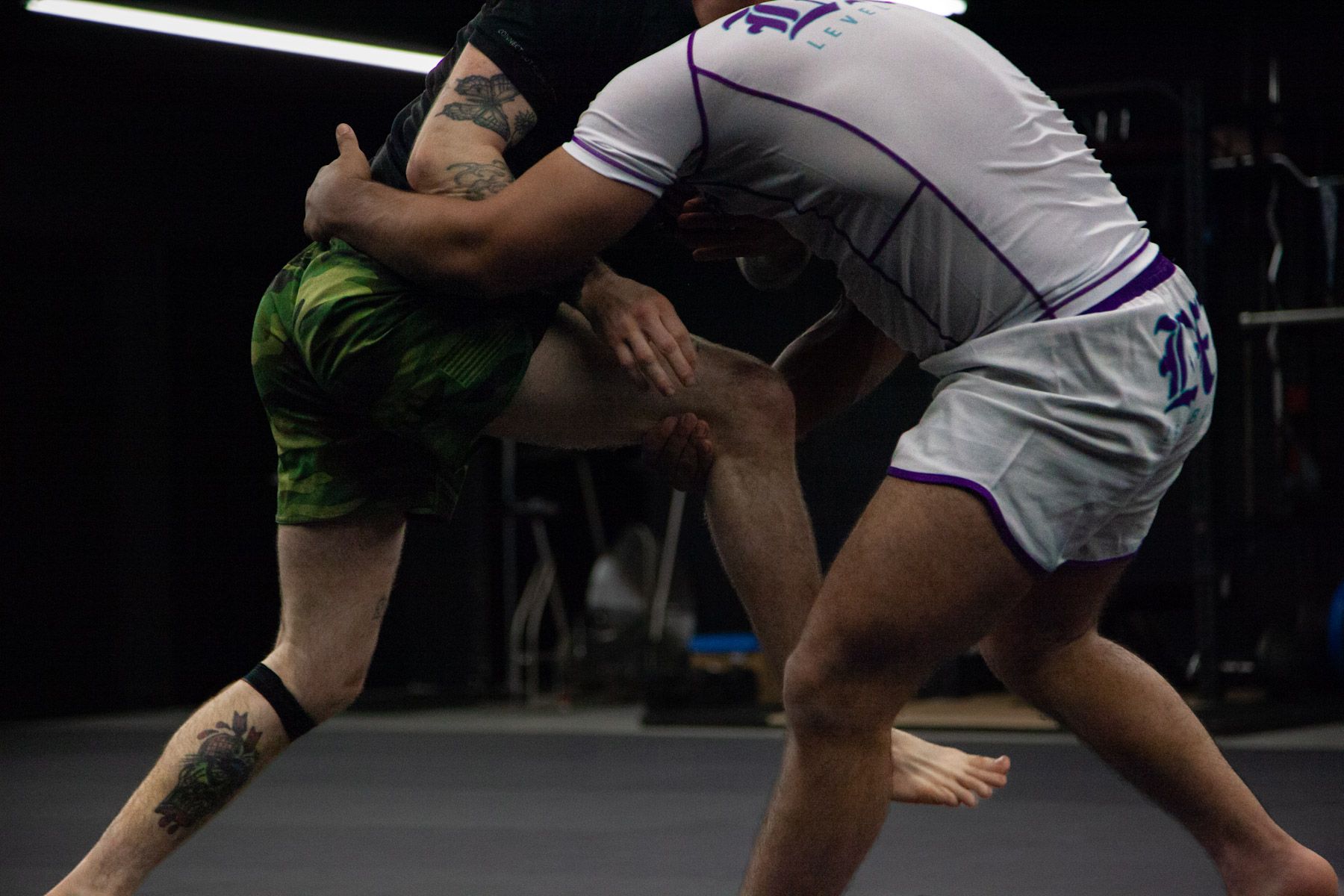
When your hips, back, and shoulders move better, your whole day feels easier, and Grappling can be the missing link.
Everyday aches rarely come from one dramatic moment. For a lot of adults in Bridgeport, pain builds quietly from long shifts, long drives, desk hours, and the way stress makes your shoulders creep up toward your ears without you noticing. Over time, you start moving around discomfort instead of through healthy ranges of motion, and that is when your back feels tight, your knees feel cranky on stairs, and getting up off the floor becomes a little too real.
We teach Grappling in a way that supports pain-free movement, not just tougher workouts. Our focus is no-gi submission grappling with a strong emphasis on controlled, live training, because your body learns best when techniques are practiced against real resistance, scaled to your level. It is practical, it is engaging, and it tends to improve the kind of mobility and strength you actually use outside the gym.
If you are looking for Submission Grappling in Bridgeport that makes you feel better in daily life, the key is understanding why ground-based movement helps, and how we structure training so you can build capacity without beating up your joints.
Why everyday aches show up in Bridgeport bodies
Bridgeport is a city where a lot of people do work that asks a lot from the body, or asks for stillness all day, and sometimes both in the same week. Repetitive lifting, standing on hard floors, carrying gear, or sitting in a fixed position can all create the same end result: your stabilizers get sleepy and your big muscles start doing everything.
That imbalance is often what people describe as tight hips, tight low back, and stiff shoulders. The issue is not just flexibility. It is control. When you cannot control a range of motion, your body protects you by limiting it, and protection can feel like tightness or pain.
Grappling gives you a structured way to rebuild that control. You are constantly learning how to distribute weight, brace your core, move your hips under you, and stay balanced while someone else tries to off-balance you. That is functional, real-world movement training, and it adds up quickly when you train consistently.
How Grappling supports pain relief without high impact
A lot of adults avoid combat sports because they picture hard falls and slammed joints. Our day-to-day training is different than that image. No-gi Grappling is mostly ground-based, and when we coach it correctly, it becomes a low-impact way to load your body through useful positions.
Instead of pounding your knees with running or jumping, you are building strength through pressure, leverage, and angles. You learn how to keep your spine stacked when it matters, how to use your hips instead of twisting your low back, and how to control your breathing under effort. Those are pain-reducing skills, even if you never care about competing.
We also scale intensity intelligently. You can roll live and still keep it safe, because we match training goals to your experience and your body. Some rounds are technical and calm, some are athletic, and both have a place.
The mobility triangle: hips, spine, shoulders
If you want less pain, these three areas matter more than most people realize. We build them in, class after class, through movements that look like Grappling, because they are Grappling.
Hips that actually rotate and extend
Hip mobility is not just being able to stretch. It is being able to move under load without pinching. In no-gi training, you use hip escapes, bridges, technical stand-ups, and pummeling patterns that repeatedly teach your hips to open, close, rotate, and stabilize.
People often notice the difference when getting out of a car, climbing steps, or standing up from a low chair. Those are hip tasks. We train hip tasks constantly, just in a more interesting format than typical mobility drills.
A spine that can brace and relax on command
Low back discomfort often comes from two extremes: your back is always tense, or it collapses when you need support. Grappling teaches you to brace with your core, not by holding your breath and hoping, but by using posture, frames, and pressure.
Because you are working against a partner, your body gets immediate feedback. If your posture breaks, you feel it. If you over-tension, you gas out. Over time, you learn a middle path: stable, but not rigid.
Shoulders that glide instead of grind
Shoulder aches love desk posture. They also love stress. We work shoulder health through scapular control, framing mechanics, and positional awareness, so you are not yanking with your arms when your hips should be doing the job.
And yes, submissions involve shoulders, but that is exactly why technique and tapping early matter. We coach you to train smart so your shoulders feel better, not worse.
What “live training” really means for pain-free progress
Live training is not about going wild. It is about practicing skills with real timing, real balance, and real decision-making. When you only drill, you can look smooth but still move poorly under pressure. When you only go hard, you might get tougher but stay inefficient.
Our approach blends teaching, drilling, and live rounds so you build patterns that hold up. For pain relief, that matters because sloppy movement under pressure is where tweaky backs and cranky knees show up. We want your mechanics to stay clean when your heart rate climbs.
Live Grappling also improves body awareness fast. You start noticing where you dump weight into your wrists, how you turn your knees inward, or when your neck takes over for your core. Those small corrections are a big deal for daily comfort.
Common aches we hear about, and how training addresses them
We cannot promise medical outcomes, and we always recommend you talk with a healthcare professional for diagnoses. But we can explain why many adults report feeling noticeably better after a few weeks of consistent training.
Low back tightness
You will practice hip escapes, bridging, and standing up with posture. That combination builds glute strength, core endurance, and coordination. Many students find that their back feels less “stuck” because the hips start doing more of the work again.
Knee irritation
Knees often complain when hips and ankles are stiff, or when your knee collapses inward during movement. Grappling improves hip control and teaches alignment in kneeling, stepping, and base-building positions. We also show you how to avoid twisting under load and how to tap early if a position is compromised.
Neck and shoulder tension
Grappling teaches you to stop leading with your head and shoulders. You learn framing, posture, and breathing. Most people are surprised how much tension is simply a habit. Training gives you a new default.
Wrist and elbow overuse
When you learn to use your whole body, your hands stop trying to do everything. No-gi grips are different than gi grips, and we emphasize leverage and position instead of death-gripping. Your joints usually appreciate that.
Adult-friendly progression: how we scale the work
Adult Submission Grappling in Bridgeport should feel challenging but doable, even if you are starting from zero. We build your base in layers so you are not thrown into situations you cannot control.
Here is what a smart progression typically looks like in our room:
1. Foundations first: posture, base, hip movement, and safe falling and getting up
2. Position before submission: you learn where your body should be before you chase a finish
3. Controlled rounds: short live rounds with specific goals, like “escape mount” or “hold side control”
4. Expanded sparring: more open rounds as your confidence and awareness improve
5. Personalization: we adjust intensity, training partners, and focuses based on your aches and goals
Most adults notice changes in how they move within 4 to 6 weeks if they train 2 to 3 times per week. The first improvement is often less stiffness. Then comes better stamina. Then you realize you are carrying yourself differently, shoulders down, steps smoother.
What you will feel in a typical class
A good class should feel organized, not chaotic. You will warm up with movements that look like Grappling because they are directly connected to what you are about to learn. You will drill techniques with coaching, not just repetition. Then you will do live work, but with structure.
You will probably sweat. You will definitely think. And you might leave with that pleasant “worked hard but not wrecked” feeling when the intensity is managed well. The mat can be humbling, but it is also oddly calming, because you cannot half-focus. You are either present or you get swept.
Practical habits that make Grappling even better for your joints
Training is the main thing, but a few simple habits help your body respond faster. We remind students of these often because the small stuff matters.
• Show up a little early so your warm-up is not rushed and your joints have time to wake up
• Tap early and often while you are learning, because progress comes from consistency, not toughing it out
• Breathe on purpose during effort, especially when you feel yourself tensing your neck
• Train 2 to 3 times per week instead of doing a single “hero session” and disappearing for two weeks
• Tell us what hurts before class so we can suggest safer options for that day
That last point is important. Adults come in with old injuries, weird tight spots, and jobs that beat them up. We would rather adjust than guess.
Why no-gi submission grappling fits Bridgeport life
No-gi is straightforward. You do not need a uniform with lapels to grab, and the movement tends to feel closer to real-world athleticism. You learn to manage friction, sweat, and scrambling in a way that builds conditioning without pounding your joints.
For Bridgeport adults, that practicality matters. You want training that improves your fitness, reduces stress, and makes your body feel more capable. Grappling checks those boxes because it is strength, mobility, and problem-solving in one session.
It also creates a routine. If you have been stuck in the cycle of “work, sit, repeat,” training gives you a place where your body moves the way it was designed to move: pushing, pulling, rotating, bracing, relaxing, and adapting.
Take the Next Step with Connecticut Submission Grappling
If pain-free movement is the goal, the right training environment matters as much as the art itself. At Connecticut Submission Grappling, we keep our focus on no-gi Jiu-Jitsu with live training, taught in a way that helps you build durable movement patterns that carry over into your workday, your weekends, and the small moments like getting up off the floor without thinking twice.
When you are ready, we will help you start at a pace that makes sense for your body, not somebody else’s highlight reel. If you want Adult Submission Grappling in Bridgeport that supports your joints while still giving you real skill, you will feel the difference in the first few weeks at Connecticut Submission Grappling.
Turn these techniques into real-world skills by enrolling in a martial arts program at Connecticut Submission Grappling.