
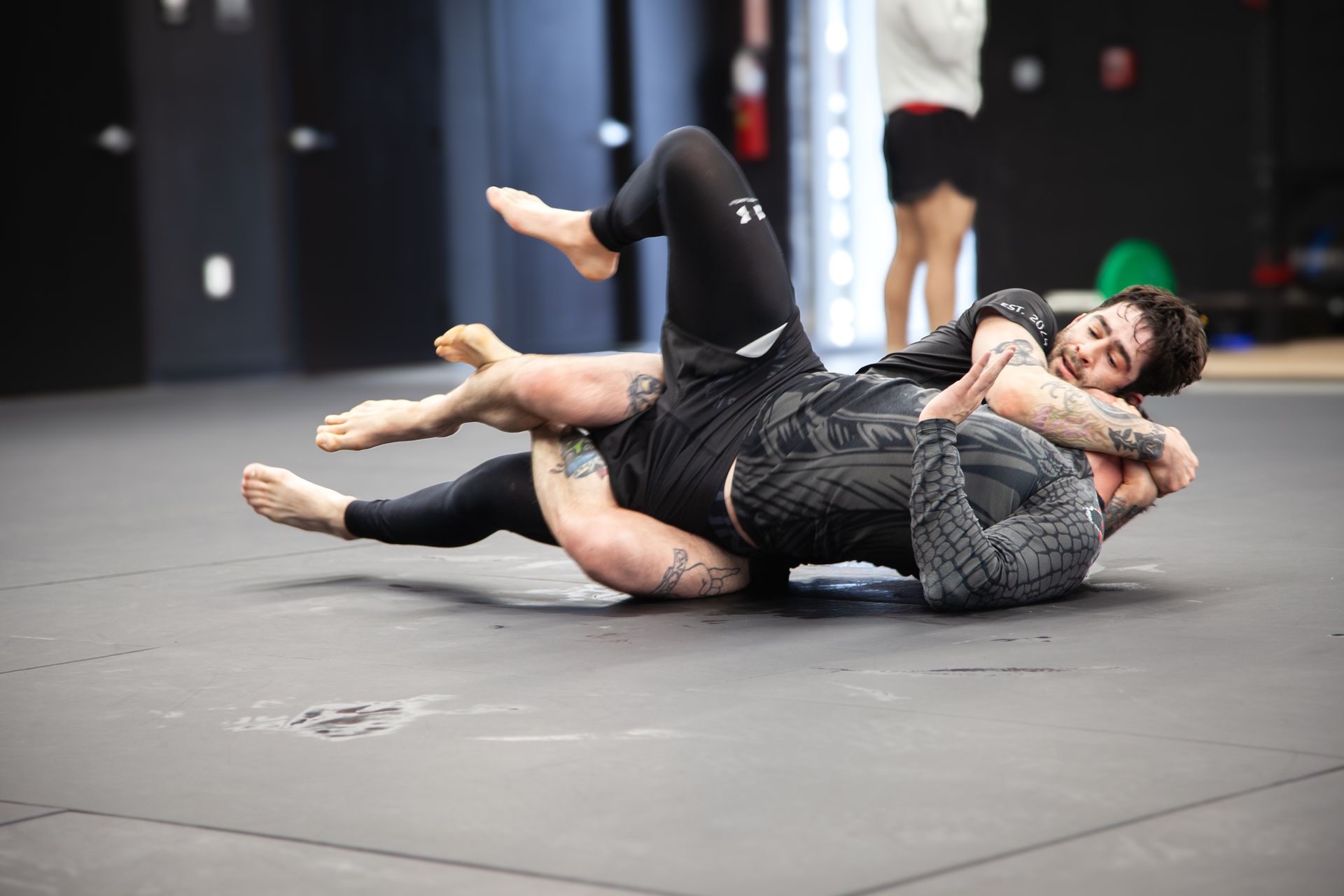
When training is built around live, controlled rounds, your fitness and recovery improve in ways most workouts cannot match.
Grappling looks like a combat sport on the surface, but the deeper you go, the more it starts to feel like applied physiology: breathing under pressure, managing fatigue, and making smart decisions while your heart rate climbs. In Bridgeport, we see people come in for skill, fitness, or stress relief, and end up surprised by how much better their bodies recover between hard efforts over time.
Our focus is no-gi submission grappling, which means you train without a kimono and rely on body mechanics, balance, timing, and friction-free control. That changes the pace. It also changes how your nervous system learns to stay calm, how your joints get stronger in real-world positions, and how you build resilience without relying on machines or mirrors.
If you are looking into submission grappling in Bridgeport, it helps to understand the science behind why it works, and how we structure training so you get the benefits without getting chewed up in the process.
What Grappling does to your body, in plain science
The most important thing to know is that Grappling is interval training disguised as a skill practice. A round is rarely steady. You surge, you stabilize, you breathe, you scramble, then you settle again. That repeated cycle trains multiple recovery systems at once.
Energy systems: why rounds build real conditioning
In live rounds, you shift between:
- Aerobic work when you are controlling position and breathing steadily
- Anaerobic bursts when you are finishing, escaping, or wrestling up
- Isometric strength when you are holding posture, pins, or frames
Over time, this improves your ability to clear fatigue and return to calm. That matters for training, daily life, and even how you sleep after a demanding day. It is not magic. It is repetition under the right dose.
Nervous system regulation: recovering faster is a skill
A big part of recovery is your nervous system learning that stress is temporary. In no-gi, you feel pressure directly: shoulder pressure, head position, tight waist control, grip fighting without fabric. When you train in a structured way, you learn to downshift, breathe, and conserve energy even while someone is actively resisting.
That is one of the reasons people often report feeling better mentally after class. You spend an hour practicing “stay calm, solve the problem,” then you walk out of the room and regular stress feels a little less sharp.
The modern no-gi trend: wrestling up, finishing with chokes
If you follow elite no-gi events, the data matches what we coach every week. Wrestling has become a dominant pathway to points and control, and takedowns surged at ADCC 2024 with 62 takedowns in the male divisions alone. Even with that wrestling-heavy landscape, submission rates stayed steady around 34 percent, similar to other top no-gi events at roughly 36 percent.
And when finishes happen, they skew heavily toward chokes. Across no-gi submission grappling, chokes account for about 65 percent of submissions, while arm attacks come in around 20 percent. That breakdown matters because it tells you what positions and controls show up again and again, from beginner rounds to high-level competition.
At the same time, guard is not “dead.” At ADCC 2024, guard work still produced meaningful outcomes like 31 sweeps, 9 back takes, and 12 submissions. So the real lesson is balance: we prepare you to wrestle, to play guard intelligently, and to finish with high-percentage mechanics.
Why Bridgeport is a strong place to learn no-gi
Connecticut has a serious wrestling pipeline, and you can feel it when you train here. Recent high school records show athletes putting up elite seasons, like 60-8 and 54-5 type win totals, and that talent base tends to flow naturally into no-gi.
That local culture influences the room in a good way. The pace is honest. The positions matter. And you get to learn how to blend wrestling entries with submission threats, which is exactly where modern Grappling is trending.
We also see statewide momentum in competition participation. The 2024 Connecticut State Championship - Gi and NoGi featured 448 athletes across divisions. When that many people show up to test themselves, it tells you the sport is growing, and the training standards rise with it.
Recovery benefits you can actually feel, week to week
Recovery is a big word, so we like to keep it practical. Here are some of the changes people commonly notice after consistent training, especially when they stick to fundamentals and do not try to win every second of every round.
Better breathing under effort
You learn to breathe through pressure. Not just “deep breaths,” but timed exhales while framing, staying relaxed in guard, and resisting the urge to tense everything at once. That skill carries into running, lifting, and stressful workdays.
Stronger joints through controlled range
No-gi positions teach your shoulders, hips, and spine to produce force while stabilized, and to accept load while aligned. When we coach frames, posture, and safe angles, you build joint integrity instead of just muscle fatigue.
Improved sleep and stress processing
Hard training plus problem-solving is a potent combination. Many students tell us they sleep heavier on training nights. That is often a sign that the body got a real stimulus and then had permission to recover.
A healthier relationship with intensity
Grappling is intense, but it is also scalable. When we structure rounds by position and experience, you learn how to go hard at the right time and how to stay technical when you are tired. That is a recovery lesson in itself.
How we structure training for safety and long-term progress
We are the only academy in the area dedicated 100 percent to no-gi Jiu-Jitsu, and that focus lets us build a clear pathway from day one. The goal is not to throw you into chaos. The goal is to help you train for years.
Foundations: controlled rounds that build confidence
For beginners, our Foundations classes are designed for 0 to 2 years of experience. We use 6-minute controlled live rounds based on specific positions like guard and pins. You are not left guessing what to do. You get a goal, a starting point, and coaching that makes the round productive.
This matters for recovery because beginners often burn out by doing too much too soon. Structured rounds let your body adapt gradually while your technique climbs faster.
All Levels: skill layering and harder starts
As you gain experience, our All Levels classes let you pressure test the same core positions with more complexity. We include standing work, wrestling entries, and the transitions that connect takedowns to control to submissions.
Because modern no-gi leans into takedowns, we treat them as a normal part of training, not a separate topic you “get to later.”
Open mats: variety without the pressure
Open mats give you time to explore, drill, and roll with different partners. That partner variety is not just fun. It is how you learn to adapt your game to different body types, tempos, and styles while keeping your movement efficient.
Efficiency is recovery. When you stop wasting energy in bad positions, you finish rounds with more in the tank.
Women’s-only classes: supportive, focused training
We offer free women’s-only classes because the sport is growing and access matters. A dedicated space can make it easier to start, ask questions, and build confidence without feeling rushed.
The “recovery loop” inside a typical class
A lot of fitness programs talk about recovery like it is something you do after training. In our room, recovery is part of the session. We coach you to feel the difference between productive effort and panic effort.
Here is what that looks like in practice:
1. Technical instruction: you learn a position with clear safety rules and key details
2. Controlled drilling: you repeat the movement at a pace where you can breathe and think
3. Positional live rounds: you apply the skill with resistance from a known start point
4. Full rounds: you connect the pieces, manage fatigue, and make choices under pressure
5. Cool down and reset: you leave the mat feeling worked, but not wrecked
This structure is one reason people doing adult submission grappling in Bridgeport often stick with it. You get challenge, but you also get a system.
What to expect if you are brand new
If you have never done Grappling, you do not need to “get in shape first.” We will scale the intensity, teach you how to move safely, and make sure you understand the basic rules of engagement. The first few weeks are mostly about learning positions, posture, and how to tap early and often. That last part is not macho, it is smart.
You will sweat. You will probably laugh at least once when something clicks. And yes, your muscles may feel sore in places you did not know existed. But soreness is different from damage, and we coach the difference.
High-percentage skills we emphasize (and why the data supports it)
We like techniques that show up under pressure. The competition trends back this up, especially the choke-heavy finish rates and the continued value of guard for sweeps and back takes. Our technical priorities stay grounded in what works when someone is resisting.
In general, we spend a lot of time on:
- Positional control: pins, head position, and staying heavy without over-squeezing
- Guard retention and guard attacks: because guard still creates sweeps and entries
- Back exposure and finishing mechanics: where many chokes become available
- Arm isolation and joint safety: effective attacks with controlled angles
- Wrestling entries and takedown defense: because the modern game rewards it
This is not about chasing trends. It is about building a skill set that holds up across partners, sizes, and intensity levels.
Take the Next Step
If you want a training plan that respects your body while still challenging you, we built our programs to deliver exactly that. At Connecticut Submission Grappling, we keep the focus on no-gi skill development, structured live training, and a room culture where you can work hard and recover well.
Whether you are exploring submission grappling in Bridgeport for fitness, competition goals, or a more resilient mind and body, we will help you start at the right pace and progress with purpose.
Train consistently and see measurable progress by joining a Brazilian Jiu-Jitsu class at Connecticut Submission Grappling.