
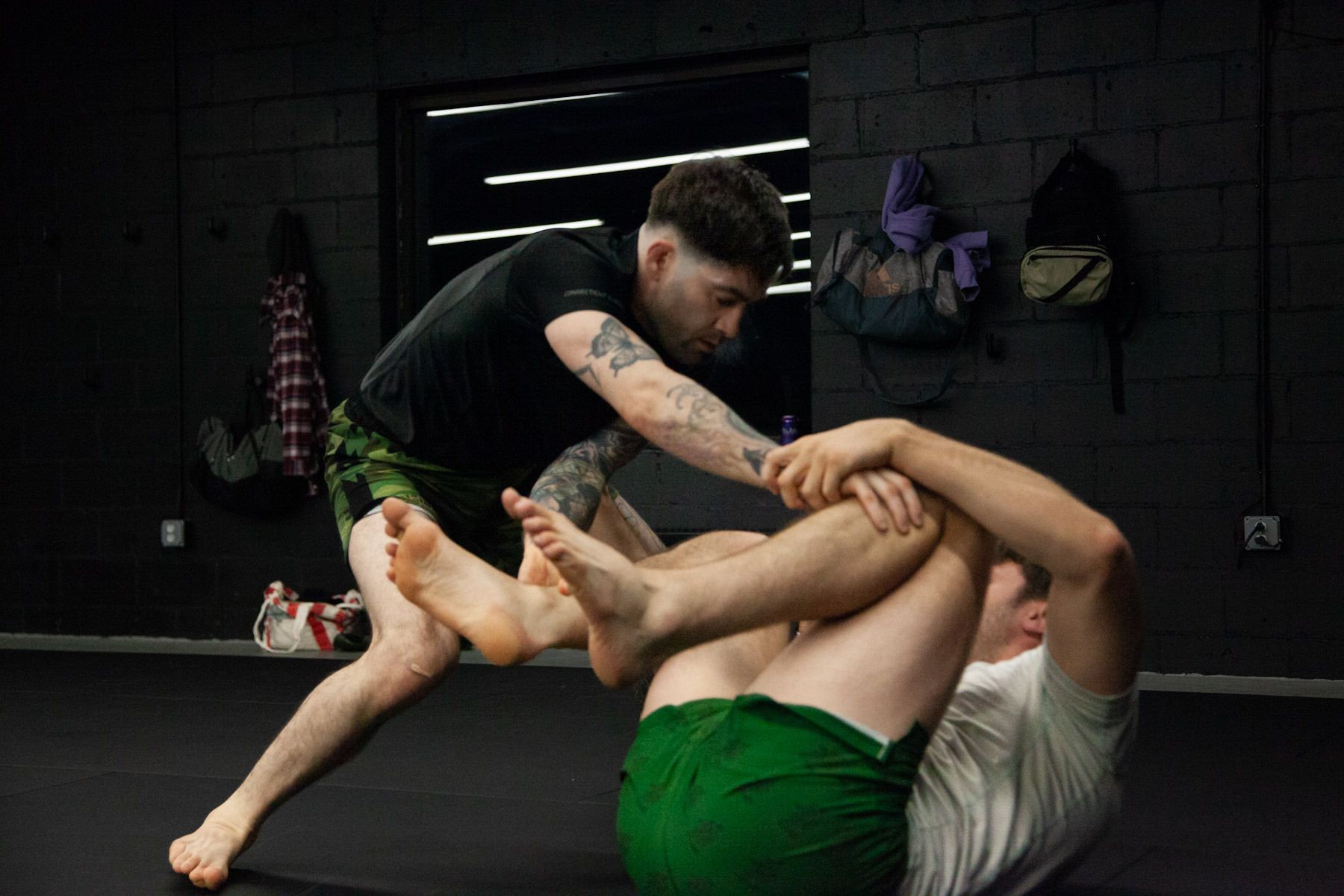
Grappling looks like a sport, but the habits it builds show up in your workday, your relationships, and the way you handle stress.
Grappling is often described as problem-solving with your whole body, and that is exactly why it transfers so well to everyday life. In our Bridgeport training room, you will spend plenty of time learning positions, escapes, and submissions, but the real surprise is what happens between the techniques. You start noticing patterns, staying calmer under pressure, and making better decisions faster.
We see it in new students who arrive unsure of what to expect, and we see it in experienced training partners who treat each round like a moving puzzle. The goal is not to win practice. The goal is to build skills you can repeat when you are tired, distracted, or having an off day, because life rarely gives you perfect conditions.
If you have been curious about Submission Grappling in Bridgeport, this is a helpful way to think about it: you are not just joining a class, you are building a toolkit. Below are some of the most useful, sometimes unexpected skills that show up off the mat once you start training consistently.
Why Grappling skills transfer so well to real life
A good training session is structured chaos. You begin with clear goals, you face resistance, you adapt, and you reset. That loop is basically the same loop you use when your schedule changes, when a project gets complicated, or when you hit a stressful moment and need to stay steady.
Because Grappling is hands-on and pressure-based, it gives you immediate feedback. If your posture breaks, you feel it. If your timing is late, you notice it. That honesty is a big reason the learning sticks. We coach you to focus on small improvements, and those small improvements compound faster than most people expect.
You learn to separate effort from panic
In daily life, stress often triggers the urge to rush. On the mat, rushing usually creates openings for someone to control you. Over time, you learn a better option: steady effort without panic. You keep breathing, you protect your position, and you work the problem in front of you.
That skill becomes practical quickly. You may still feel stress, because you are human, but you stop letting stress drive the decision-making. It is a subtle shift, and it is one of the most useful things you can take from training.
You practice under pressure in a controlled way
Pressure is part of Grappling, literally and mentally. The difference in training is that pressure is controlled, supervised, and gradually increased. We build intensity in a way that supports safety and progress, so you learn to function when things feel heavy without having to “tough it out” blindly.
In everyday terms, you build tolerance for discomfort. Not the dramatic kind. The normal kind: uncertainty, tight timelines, hard conversations, and moments when you need to stay composed.
Communication without words: awareness, boundaries, and respect
One of the most overlooked life skills in Grappling is nonverbal communication. Training partners are constantly “talking” through grips, posture, pace, and pressure. You learn to read tiny cues: a weight shift, a hand position, a hesitation that signals an opening.
That kind of awareness helps outside the gym, too. You get better at noticing when someone is uncomfortable, when a situation is escalating, or when you need to slow down and reset the tone.
Healthy boundaries become real, not theoretical
On the mat, boundaries are practical. You learn what safe resistance feels like and what reckless resistance feels like. You learn to tap early, respect the tap, and communicate if something feels off. That carries into life in a grounded way, because you practice it repeatedly.
We keep a training culture where you can ask questions, pause, and adjust. That approach matters for adults, especially. Many people have not been in a learning environment where it is normal to say, “Can we go lighter?” and be respected for it.
The decision-making skill most people do not expect
Grappling forces you to make decisions with incomplete information. You cannot see everything. You cannot predict everything. You have to pick a direction and commit, then change it if the situation changes. That is a rare kind of practice, and it is incredibly useful.
You get better at prioritizing what matters
When someone is passing your guard, you cannot fix everything at once. You prioritize frames, hip movement, and recovery. In life, the same principle applies. You stop trying to solve ten problems at the same time and start solving the one that unlocks the rest.
We coach this constantly in class. We would rather you do a few fundamentals well than chase every flashy option. The same mindset tends to clean up people’s routines outside the gym, too.
You learn to commit, then adjust without ego
A lot of people struggle with changing their mind because it feels like “being wrong.” Training makes adjustment normal. You try something, it fails, you learn, you try again. There is no shame in it, just feedback.
That process is one reason Adult Submission Grappling in Bridgeport can be so appealing. Adults usually want training that respects their time and gives them a clear path forward. The mat teaches efficiency.
The quiet confidence that comes from real competence
Confidence is a slippery word, so we prefer something more concrete: competence under pressure. When you train regularly, you start to trust your ability to handle difficult positions. You learn that you can be uncomfortable and still think clearly. That changes how you carry yourself.
This is not about being aggressive. It is about being harder to rattle.
You get comfortable being a beginner again
Many adults avoid new activities because being new feels awkward. Grappling puts you back in that beginner space, but in a supportive way. You learn that awkward is temporary, and progress is predictable when you show up.
We see new students relax once they realize nobody expects perfection. We expect effort, curiosity, and respect. That is it.
You develop self-control, not just physical control
Training gives you chances to choose restraint. You can apply a technique cleanly without cranking. You can win a position without making it personal. That matters, because self-control is a life skill that shows up everywhere: driving, parenting, work, and stressful conversations.
Fitness benefits that feel practical, not random
Yes, Grappling will challenge your conditioning, but it does it in a way that feels usable. You build strength in your hips, core, and grip. You develop balance and coordination. You learn to move your body as a unit, not as separate parts.
Many students tell us they like that the workouts do not feel like counting reps for the sake of counting reps. You are solving movement problems, and the fitness shows up as a side effect.
Realistic cardio: bursts, recovery, and repeat
A typical round includes bursts of effort and moments where you must recover while still defending. That pattern matches real life better than steady-state cardio alone. You learn how to bring your breathing down while still working, which is a skill you can feel immediately.
Mobility and joint awareness improve over time
Because positions require you to move through range of motion with control, you tend to develop better joint awareness. We still encourage smart pacing, especially if you have old injuries or stiffness from sitting all day. The goal is longevity. Training should support your life, not beat you up.
What you actually practice in our classes, and why it matters
Our classes are built around live learning. You will drill, you will ask questions, and you will practice with resistance in a way that matches your level. We focus on no-gi movement and control, and we keep the training environment friendly but serious about improvement.
Here is what that looks like in a typical week of training, and how it maps to life outside the gym:
• Positional control and escapes that teach you patience, timing, and how to stay calm while you work
• Takedown entries and clinch awareness that improve balance, confidence, and body coordination
• Guard work that develops problem-solving, flexibility in thinking, and comfort in transitional moments
• Submissions taught with safety and precision, reinforcing responsibility and self-control
• Live rounds that train composure, decision-making, and recovery when things do not go your way
That mix is why Submission Grappling in Bridgeport can feel like more than a workout. You are training your nervous system to stay useful when it matters.
A simple way to start, even if you are busy
Adults in Bridgeport have full schedules. We get it. The easiest way to start is to make your first few weeks about consistency, not intensity. Let your body adapt, learn the culture, and build the habit.
If you want a straightforward plan, here is what we recommend for most new students:
1. Pick two class times from the class schedule and protect them like appointments for the first month
2. Show up a little early so you are not rushed and can warm up properly
3. Focus on defense first: posture, frames, and escapes before chasing submissions
4. Ask one question per class and write down the answer afterward so it sticks
5. Increase intensity gradually, aiming to leave practice feeling better than when you arrived
This is especially effective for adults who want Adult Submission Grappling in Bridgeport as a long-term practice, not a short burst of motivation.
The Bridgeport factor: community, pace, and real-world resilience
Training in Bridgeport has its own rhythm. People work hard, schedules are real, and nobody has time for fake progress. We keep our coaching direct and practical, and we build a room where you can train seriously without feeling like you have to prove something every day.
Over time, you will notice the “Bridgeport benefit” in how you handle pressure. You stop reacting to small setbacks like they are huge problems. You breathe, reset your base, and keep moving forward. It sounds simple, but it changes your week in a way that is hard to unsee once you feel it.
Take the Next Step
If you want training that improves your fitness and teaches you how to stay composed under pressure, we built our programs to do exactly that at Connecticut Submission Grappling. Grappling is the vehicle, but the real win is learning how to think clearly, move confidently, and keep showing up even when things feel challenging.
When you are ready, we will help you start at a pace that makes sense for your body and your schedule. Connecticut Submission Grappling is here in Bridgeport, and we keep the path simple: learn the fundamentals, train with purpose, and build skills that carry into the rest of your life.
Take the first step toward stronger skills and confidence to start training at Connecticut Submission Grappling today.