
If you can control where the fight happens, you can control the outcome.
In Bridgeport, athletes come from every kind of background: team sports, strength training, combat sports, and plenty of people who just want a tougher, more capable body. No matter where you start, Grappling has a way of exposing the same truth fast: if you cannot manage contact, balance, and pressure, your conditioning and athleticism only take you so far.
Our classes focus on building real, repeatable skills you can use under resistance. That matters because performance does not happen in perfect positions. It happens when you are tired, your posture is broken, and somebody is trying to take your space. That is where good training shows up.
We also like keeping things honest with data. In 2024, 40.5 percent of professional-level matches ended in submissions, with back chokes leading the way at 22 percent of finishes. Armbars followed at 12 percent, and heel hooks accounted for 8 percent. At the amateur level, about one-third of matches still end in submission. Those numbers reinforce what we see every week: the athletes who win exchanges are usually the athletes who can build position, create control, and finish with fundamentals.
Why Grappling Is a Bridgeport Athlete Advantage
You do not have to be a full-time competitor to benefit from Grappling. If you play football, you already understand hand-fighting and leverage. If you play basketball, you already understand angles and timing. If you lift, you understand output. Grappling turns all of that into something you can apply against another human being who is resisting, adjusting, and pushing back.
What makes it such a strong “athlete skill” is that it rewards efficiency. Strong people who rely on strength only get tired. Fast people who rely on speed only get caught. Technical athletes learn to spend energy where it pays off, and save energy everywhere else. Over time, that becomes a real edge, whether you are training for sport, self-defense, or just to feel more confident in close contact situations.
Master Skill 1: Base, Posture, and Balance Under Pressure
If we had to pick one category that quietly controls everything else, it is base and posture. Most problems in Grappling start when your spine is bent in the wrong direction, your hips are disconnected from your feet, or your weight is drifting past your ability to recover.
We teach you how to build a stable athletic stance on the ground, not just standing. That means understanding how to post with a hand, elbow, or foot without giving away easy attacks. It also means learning how to keep your head and hips aligned so you can generate force without getting folded.
A practical example: when somebody tries to pull you forward, your instinct might be to yank back. We train you to widen your base, adjust your knee line, and re-stack your posture first. It feels small, but it is the difference between staying safe and getting snapped into a front headlock series.
Master Skill 2: Escapes First, Then Offense
Athletes sometimes want to jump right to the cool part: submissions. We love submissions too, but we build your success around escaping bad positions before we ask you to finish from good ones.
Escapes give you something priceless: permission to try. When you know you can get out of bottom side control, recover guard, or clear a choke attempt, you can play more open and learn faster. Without that confidence, people get stiff and hesitant, and training starts to feel like survival instead of skill-building.
Our goal is for your escapes to become systematic. Not frantic. You learn frames, hip movement, timing, and when to accept a smaller loss to avoid a bigger one. That is a very “athlete” skill, honestly, because it is the same idea as giving up a point to reset rather than getting pinned and losing the game.
Master Skill 3: Guard Retention and Recovery (Staying Hard to Pin)
Guard retention is one of those skills that looks like chaos until you understand it. Then it becomes a clean set of concepts: inside position with your legs, strong frames with your arms, and smart hip angles that stop your opponent from settling their weight.
We teach guard as a set of solutions, not a single stance. Sometimes you are playing open guard, sometimes you are re-guarding from a scramble, and sometimes you are just trying to get your knees back between you and pressure. For athletes in Bridgeport who want to stay durable, guard retention is also a joint-saver. It reduces the amount of time you spend getting flattened and twisted.
A small but important detail we coach: your guard is not just your legs. Your guard is your ability to manage distance. When your distance management is good, passing becomes exhausting for the other person, and that changes the whole tempo of a round.
Master Skill 4: Passing With Pressure and Purpose
If guard retention is staying hard to pin, passing is learning to become impossible to shake off. We build passing around posture, grips, head position, and incremental wins. Passing is rarely one big move. It is usually three or four small improvements stacked together until your opponent cannot recover.
We teach you to feel when to switch from speed to pressure. A lot of athletes start by trying to sprint around the legs, which works until the defender has good frames and timing. Pressure passing is where you learn to connect your weight to the mat through your opponent, making their hips heavy and their shoulders uncomfortable. It is not about being mean. It is about being effective.
We also emphasize something that makes passing work in real training: patience. When you rush, you give the guard player the exact moment they need to recompose. When you settle, crossface correctly, and win the hip line, you can pass without taking unnecessary risks.
Master Skill 5: Clinch and Takedown Entries That Actually Connect
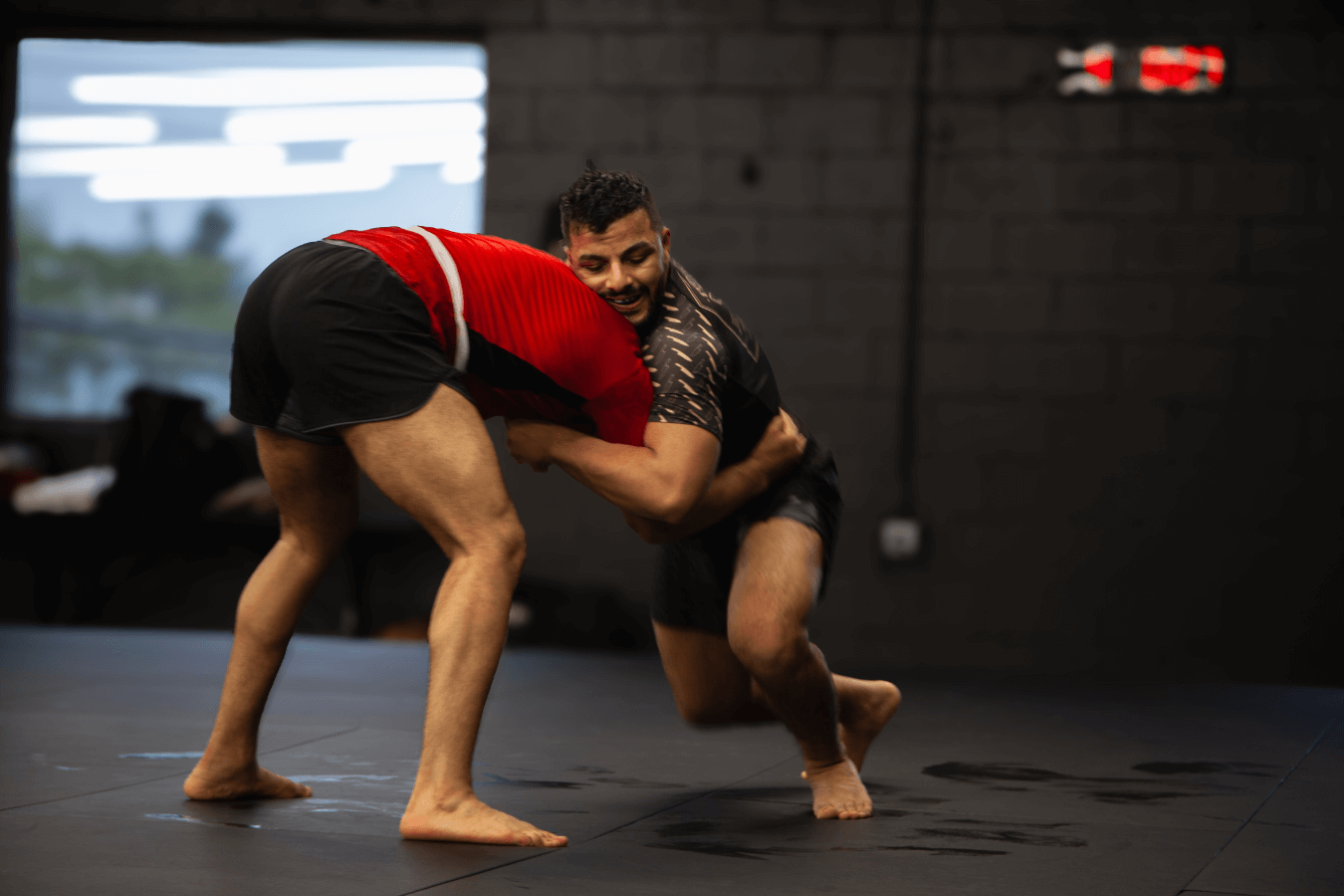
In a perfect world, every takedown looks clean. In the real world, most takedowns come from contact and hand fighting. That is why we train the clinch as a core Grappling skill, not an afterthought.
You learn how to pummel for inside control, how to manage head position, and how to move your feet while you are tied up. It is not glamorous, but it is exactly what lets your takedowns “stick.” The goal is not to hit a highlight reel shot. The goal is to put somebody on the ground while staying safe and balanced.
For athletes, clinch training also improves body awareness in a way that is hard to get elsewhere. You start noticing leverage points: elbow position, shoulder pressure, hip alignment. You feel when somebody is about to change levels before they do it. That is real mat intelligence.
Master Skill 6: Back Control and Chokes (Because the Stats Do Not Lie)
If back chokes account for about 22 percent of finishes at the professional level, that is not a coincidence. The back is the most dominant control position because it limits your opponent’s ability to face you, strike you, or generate strong escapes without exposing the neck.
We teach you how to take the back with control, not desperation. That includes seatbelt mechanics, hook positioning, and keeping your chest connected so you can follow the defender’s movement. From there, we build finishing skills that are reliable under pressure, including rear-naked choke mechanics and hand-fighting sequences.
Chokes are also a technical honesty check. If you try to muscle a choke, your arms burn out and your partner escapes. When you do it correctly, it feels strangely smooth, like the finish happens with less effort than you expected.
Master Skill 7: Armbars and Straight-Arm Control for High Percentage Attacks
Armbars are timeless for a reason. They work across rule sets, they punish poor posting, and they connect naturally from many positions. Since armbars represent about 12 percent of submission finishes at the pro level, we treat them as a core finishing pathway, not a “someday” technique.
We coach armbars as a control problem first. Can you isolate the elbow line? Can you control the shoulder rotation? Can you prevent the stack? When you can answer yes, the finish becomes simple.
You also learn when not to chase it. A failed armbar attempt can cost you position if you throw it without control. So we build your decision-making: when to attack, when to transition, and when to take the safer improvement, like coming up to top position.
Master Skill 8: Leg Lock Awareness and Responsible Training
Leg locks have become increasingly prevalent at elite competitions, and heel hooks alone make up around 8 percent of recorded pro-level submissions. That trend is not going away, which means athletes need awareness, defense, and a responsible way to train.
We teach leg lock fundamentals with safety and control at the center. That includes recognizing common entanglements, understanding knee line exposure, and learning how to clear your foot and reestablish position. We also coach tapping early and communicating clearly. That is part of being a good training partner, and it is how you get better without getting hurt.
For many athletes, just learning leg lock defense changes their whole game. You stop panicking when somebody touches your feet, and you start seeing the path back to base and balance.
What You Will Experience in Our Adult Training Environment
When people search for adult submission grappling in Bridgeport, they usually want three things: a clear path to progress, training partners who take the work seriously, and a room that feels welcoming the first day. We design our classes to deliver that without making you guess where you fit in.
Here is what we focus on, week to week:
• Technical instruction that stays grounded in fundamentals like posture, frames, and positional control
• Progressive resistance so you can practice safely before you go full speed
• Positional rounds that isolate key scenarios like escapes, guard passing, and back control
• Live training that builds timing, conditioning, and composure under pressure
• Coaching that helps you connect the dots between technique and decision-making
If you are new, we help you build a foundation without drowning you in details. If you are experienced, we help you sharpen the pieces that decide rounds: entries, transitions, and finishes you can repeat.
How to Measure Progress Without Overthinking It
A lot of athletes want to know if they are “getting better,” and that is fair. Grappling progress can feel invisible because you might still tap, even while you improve. We encourage you to track a few simple indicators that show real skill growth.
1. You escape bad positions with less panic and less effort
2. You can hold top pressure longer without burning out
3. You recognize threats earlier, especially chokes and leg entries
4. You can finish one or two submissions cleanly against similar experience levels
5. You recover faster between rounds because your movement is more efficient
Those are practical milestones. They do not require a tournament medal to prove they matter, and they show up in training quickly when you train consistently.
Experience Submission Grappling in Bridgeport With a Clear Plan
The difference between random training and real development is structure. That is what we build at Connecticut Submission Grappling: a skill progression that helps you become harder to control, harder to submit, and more effective in every position. If you are looking for submission grappling in Bridgeport that respects fundamentals while still keeping training challenging, we are ready to help you get started.
You do not need to be “in shape first” or have years of experience. You just need a willingness to learn, show up, and stay consistent. We will take care of the plan, the coaching, and the training environment at Connecticut Submission Grappling.
Train with focus and see measurable progress by joining a grappling class at Connecticut Submission Grappling.