
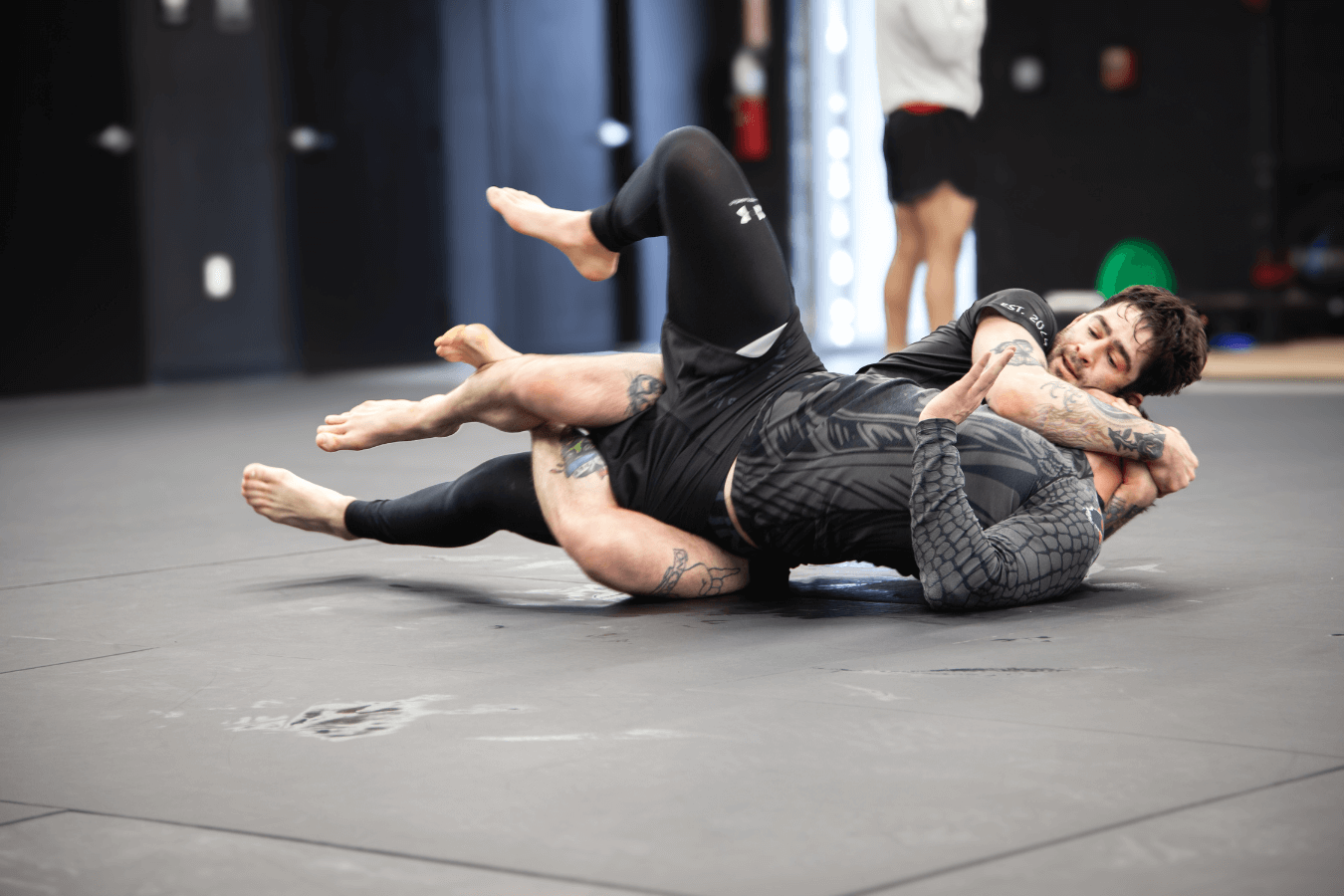
Grappling is one of the rare workouts that asks your body to move while your mind learns to stay calm.
Busy schedules, constant notifications, and daily pressure can leave your attention feeling scattered. In Bridgeport, that mental noise is real, and it tends to follow you everywhere, from work to home to the drive in between. That is one reason we see so many adults walk into our gym looking for something more than another cardio routine.
Grappling gives you a practical way to train focus on purpose. Every round puts you in a problem-solving situation where you have to breathe, prioritize, and make decisions under pressure. Over time, that practice can translate into clearer thinking off the mats, too, because you have rehearsed what it feels like to stay steady when things get tight.
In this article, we will break down how submission grappling in Bridgeport can support mental clarity, what the research suggests, and how our adult classes are structured to help you build focus safely and consistently.
Why Grappling Clears Your Head When Nothing Else Does
Mental clarity is not just feeling relaxed. It is being able to direct attention, filter distractions, and make good choices quickly. Grappling trains that in a very grounded way because you do not get to “multi-task” during a live exchange. If your mind wanders, you lose position. If you hold your breath, you fatigue. If you panic, you give up opportunities.
That is why many people report a clear, quiet mind after training. You have spent an hour doing one thing fully. Even if you came in stressed, you leave with that “reset” feeling that is hard to fake.
There is also data behind this. In one set of findings often cited in Brazilian Jiu-Jitsu circles, 87.5 percent of adult practitioners reported reduced anxiety, 81.3 percent noted improved mental flexibility, and 87.6 percent experienced increased confidence. Those numbers line up with what we hear from new students: sharper focus at work, less reactivity at home, and a stronger sense of control when life throws curveballs.
Focus Under Pressure: The Real Skill We Practice Every Class
Your attention has a job during every roll
In Grappling, focus is not abstract. You are tracking grips, posture, weight shifts, and timing. You are reading what your partner is doing while managing your own base and breathing. That is a lot, but it is also why the brain benefits. You are training attention like a muscle.
We coach you to narrow your focus to what matters most in the moment. A simple example: if you are pinned, you do not need ten techniques. You need one escape sequence and the patience to work it step by step. That mental discipline is a skill, and it grows fast when you practice consistently.
Decision-making gets faster and calmer
When you first start, everything can feel urgent. Then something interesting happens: you learn that urgency is not the same as effectiveness. You learn to pause just enough to choose a better option. That is mental clarity in action.
Over time, Grappling becomes a decision-making laboratory. You try a solution, get feedback immediately, and adjust. That cycle of attempt, result, and refinement is one reason training supports mental flexibility. You are literally practicing adaptability.
Anxiety Reduction and the “Pressure Test” Effect
Anxiety often comes from anticipating chaos, feeling unprepared, or worrying you will not be able to handle a situation. Grappling addresses that from multiple angles at once: physical exertion, controlled discomfort, and repeated exposure to pressure in a safe environment.
In the research, adult BJJ practitioners frequently report reduced anxiety and improved mood, including a 96.9 percent rate of mood improvement in one dataset. The mechanism is not magic. It is practice. You learn that pressure is survivable, that your breathing can slow your heart rate, and that you can keep thinking even while working hard.
We structure training so you build this gradually. You start with fundamentals and positional work, then progress to controlled sparring. That progression matters because it keeps the “pressure test” productive rather than overwhelming.
The Mindfulness Side of Grappling (Without Having to Sit Still)
Mindfulness is often described as paying attention to the present moment. Grappling forces you into the present moment, whether you planned to be there or not. You cannot scroll. You cannot drift. Your partner is right in front of you, and your body is giving you constant feedback.
That is why many students tell us they feel mentally quieter after class. It is not that problems disappear. It is that the brain stops spinning long enough to reset. You get a break from rumination, and you earn it by doing something real.
A common surprise for adults trying adult submission grappling in Bridgeport is that the calm comes during the hard rounds, not after. Once you learn to breathe through tension, you start to experience effort without panic. That is a powerful shift.
Resilience, Grit, and Why Experience Level Matters
One of the strongest trends in the research is that benefits increase with experience. Studies comparing belt levels show black belts scoring higher in mental strength, self-efficacy, self-control, and life satisfaction than white belts, with a small positive relationship between training time and these mental outcomes.
We see a practical version of that in everyday training. Beginners build confidence by learning escapes, positions, and basic submissions. More experienced students refine timing, patience, and strategy. The technical details change, but the mental work stays consistent: stay composed, adapt, and continue.
If you are starting from scratch, do not worry about the long road. You do not need years of training to feel a difference. Many people notice emotional benefits within the first few months, especially with consistent attendance. Long-term training just deepens the effect.
Mental Clarity You Can Use on a Tuesday Afternoon
It is easy to talk about mindset in theory. We prefer to talk about the practical moments where it shows up.
Common “transfer” skills our students notice
Here are a few ways the mental habits from Grappling often carry into daily life:
• Better prioritization under stress, because you are used to identifying what matters most in a chaotic exchange
• Improved emotional control, because you practice staying calm while your body works hard
• Stronger follow-through, because progress in technique comes from showing up consistently
• More confident communication, because training builds self-efficacy through real feedback
• Faster recovery after setbacks, because every round includes small “failures” that teach adjustment
These are not motivational slogans. They are skills you rehearse in a live environment, then naturally bring into work meetings, family life, and everything in between.
What Adult Submission Grappling in Bridgeport Looks Like in Our Gym
Adults often want to know what they are actually walking into. Our goal is to make the learning curve feel challenging but doable.
A typical class includes technique instruction, drills that build timing, and live training scaled to your level. We keep the room structured so you can focus. That structure matters for mental clarity. When you know the plan, your brain can relax into the work instead of guessing what is next.
We also keep training collaborative. You will work with partners who want you to improve, because that is how the room gets better. Community is a mental health factor that gets overlooked, but it matters. In one survey-based finding, 100 percent of participants reported a sense of community through training. That connection helps reduce stress and makes it easier to stay consistent.
If your schedule is tight, our class schedule page on the website is the easiest way to plan your week. Consistency is where the mental benefits really start to stack.
A Simple Timeline: When You Might Feel the Mental Benefits
Everyone is different, but we can give you a realistic framework based on what we see and what the research suggests.
1. First 2 to 4 weeks: You feel the “reset” after class, plus early confidence from learning fundamentals and surviving hard work
2. Around 8 to 12 weeks: Anxiety tends to drop, decision-making improves, and you start thinking more clearly during sparring
3. After 6 months and beyond: Resilience becomes noticeable outside the gym, and stressful situations feel less personal and less overwhelming
4. Long-term training: Mental strength, self-efficacy, and self-control continue to grow, especially as your technical comfort increases
The key is steady practice. You do not need to train every day, but you do need enough repetition that calm becomes familiar.
Grappling and Mental Health Conditions: A Responsible Perspective
We take mental well-being seriously, and we also want to be clear about what training is and is not. Grappling can be a powerful complement to a healthy lifestyle, and research increasingly discusses BJJ as a promising public health intervention for resilience, emotional regulation, and reduced symptoms in groups like veterans and first responders. There are longitudinal findings pointing to sustained PTSD symptom reductions and cognitive improvements as training continues.
At the same time, training is not a replacement for professional care. If you are managing PTSD, depression, or high anxiety, we encourage you to talk with your doctor or therapist and approach training as one supportive tool among others. We can also help you ease in with a pace that feels safe, because intensity is adjustable and progress does not require going to extremes.
Take the Next Step
If you want a sharper mind, you need a training environment where focus is built into the process, not tacked on as an afterthought. That is exactly why we coach the way we do, from fundamentals to live rounds that teach you how to stay calm under pressure.
At Connecticut Submission Grappling, we use Grappling to help Bridgeport adults build mental clarity through practical problem-solving, structured classes, and a community that makes consistency easier. If you are curious about adult submission grappling in Bridgeport, the next step is simple: look at the class schedule, come in for a trial session, and feel the difference a focused hour on the mats can make.
Ready to train? Join a grappling class at Connecticut Submission Grappling today.