
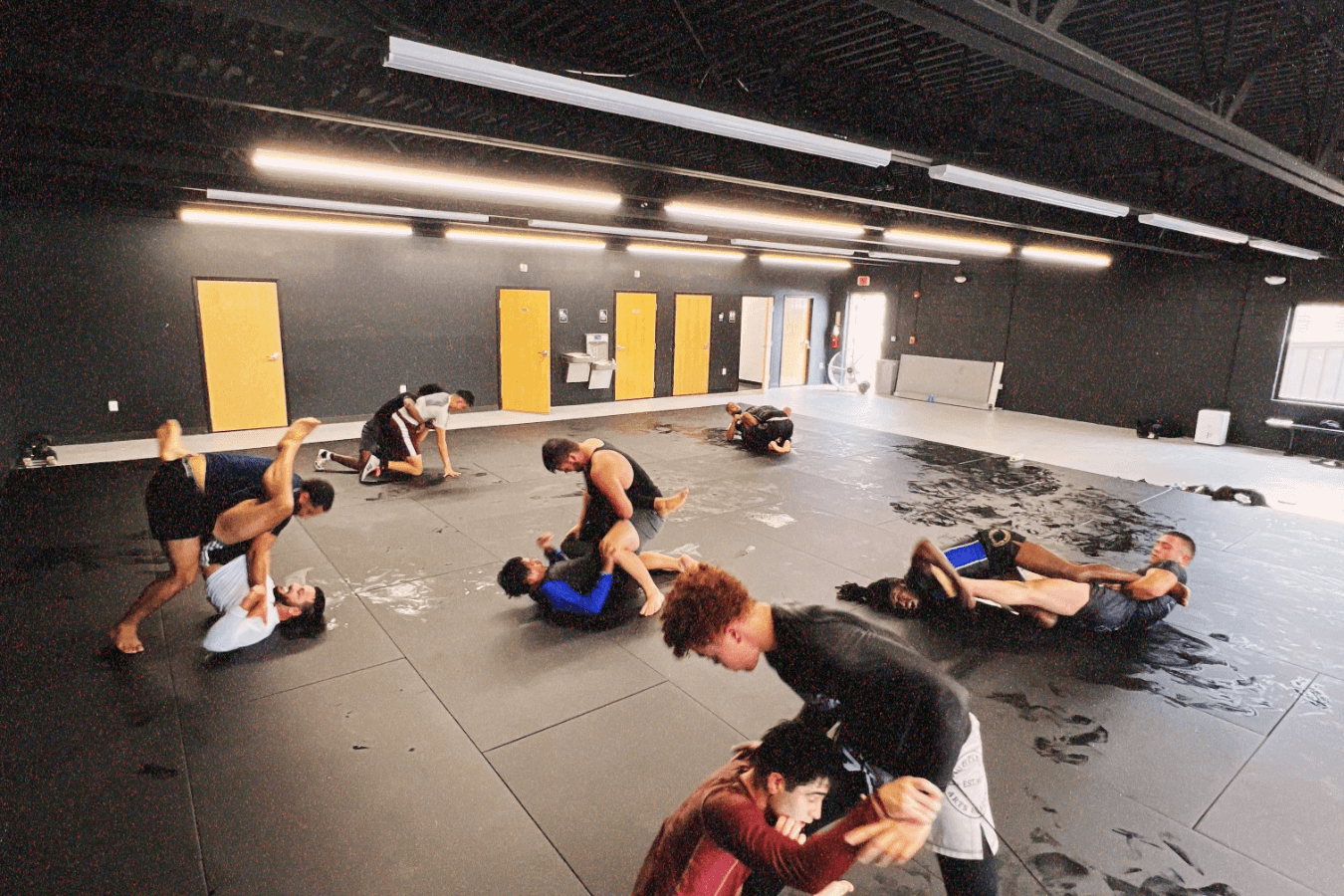
Grappling gives teens a place to practice composure, accountability, and real leadership under pressure.
In Bridgeport, teens juggle a lot: school expectations, social pressure, changing bodies, changing priorities, and a world that rarely slows down. That is exactly why Grappling works so well at this age. It is physical, yes, but it is also structured, demanding, and honest. When you train consistently, you cannot fake focus or effort for long. Your habits show up fast.
Our No-Gi training is built around live practice, not memorizing long scripts. That matters for teens because confidence is not something you hear about once and magically feel. Confidence comes from doing hard, safe things repeatedly, with guidance, and learning how to stay calm when the round gets uncomfortable.
We also keep the environment practical. Teens learn how to move, how to control positions, and how to problem-solve with a partner who is actively resisting. That constant feedback loop is where discipline starts to look like a real skill, not just a motivational word.
Why Grappling clicks for teens in Bridgeport
Teen years are a perfect window for building the traits that adults spend years trying to develop later: consistency, self-control, and the ability to learn from mistakes without spiraling. Grappling naturally trains those traits because every round is a little test of decision-making.
When a teen gets stuck under pressure, the solution is rarely panic. It is posture, frames, breathing, and a simple next step. Learning that pattern on the mats tends to spill into school and home life. A tough exam or a tense conversation stops feeling like an emergency and starts feeling like a problem to work through.
Bridgeport teens also benefit from having a positive, structured space where expectations are clear. Show up on time. Respect training partners. Do the work. Take coaching. Those are basic rules, but they add up to leadership habits when practiced week after week.
Discipline that is earned, not demanded
A lot of teen activities rely on external enforcement: a coach yells, a teacher threatens a grade, a parent repeats the same reminder. In our classes, discipline gets trained from the inside out. If you skip warm-ups mentally, your movement suffers. If you rush techniques, you lose positions. If you act careless, you get tired faster and your partner notices.
Over time, your teen starts to connect cause and effect:
• Preparation leads to better performance
• Consistency beats intensity that only shows up once in a while
• Calm decision-making creates opportunities, even when tired
This is one of the most useful things Grappling can give a teen. You do not have to convince yourself discipline matters. You feel it immediately in training.
Leadership skills you can actually see
Leadership is not just being loud or being the captain. On the mats, leadership often looks quieter: being a good partner, staying controlled, and setting a standard without making a speech about it.
We coach teens to lead in ways that fit their personality. Some will naturally mentor newer students. Others lead by staying steady and reliable. Either way, Grappling gives immediate chances to practice leadership in small moments:
• Helping a newer student understand a position without overpowering
• Resetting after a tough round instead of blaming a partner
• Holding a high standard for hygiene, safety, and respect
• Taking feedback and applying it quickly, even if it stings a little
Those moments build real confidence because they are earned in a setting that does not hand out easy wins.
Our No-Gi, live-training approach and why it matters for teens
We are dedicated exclusively to No-Gi Jiu-Jitsu with 100 percent live training. That means every class includes sparring, scaled to experience and comfort level. Teens do not just learn techniques in the air. We teach them to make techniques work against realistic resistance in a controlled environment.
Live training does not mean chaos. It means structure. We use progressive rounds that match the student. Beginners spend time in controlled games from key positions like guard and pin control. As skill improves, we widen the options: longer rounds, more standing starts, more problem-solving.
This approach is also safer than people assume, because pacing and rules are clear. We emphasize control, tapping early, and training with partners who care about learning, not proving something.
The teen progression: what growth looks like over a few months
Parents often ask what changes we expect to see, and when. Every teen is different, but the pattern is surprisingly consistent when training is steady.
Month 1: Learning the language and the rhythm
Your teen learns basic movement, how rounds work, how to tap, and how to stay composed while learning. This phase can feel awkward, and that is normal. Grappling has a learning curve, and we coach teens through it patiently.
Months 2 to 3: Better decisions under pressure
Positions start to make sense. Teens begin to recognize common patterns: how people pass, how pins happen, and how to recover guard. This is also when discipline starts to show up because the teen realizes improvement is tied to repetition.
Months 4 and beyond: Ownership and leadership behaviors
Now your teen starts to self-correct. You might hear phrases like, I should have framed earlier, or I rushed the scramble. That kind of reflection is a leadership trait. It is taking responsibility without drama.
Wrestling and takedowns: the modern Grappling reality
If you watch high-level No-Gi competition, the trend is clear: wrestling and takedowns matter more than ever. At the 2024 ADCC World Championships, takedowns played a major role across divisions, and the match outcomes often depended on who could win the standing exchanges and control the transitions.
For teens, learning wrestling fundamentals is not about becoming a wrestler overnight. It is about learning balance, pressure, hand-fighting, and how to stay safe when someone is trying to off-balance you. We build those skills progressively, so teens get confident without getting thrown into the deep end too fast.
And when it comes to submissions, modern No-Gi trends also show a heavy emphasis on chokes. That reinforces an important lesson: control and positioning win more reliably than hunting random moves. We teach teens to prioritize strong mechanics and smart choices.
What your teen learns in class (practical, not theoretical)
We want you to understand what training actually looks like, because it is not a mystery program. A typical class includes guidance, coaching, and plenty of live reps.
Here is what we focus on most often:
- Positional control: how to hold top pressure safely and how to escape pins with technique
- Guard work: how to retain guard, off-balance, and create safe angles to attack or stand up
- Submissions with responsibility: applying pressure gradually, recognizing taps quickly, and protecting training partners
- Transitions and scrambles: learning to move from one position to another without giving up control
- Live rounds scaled to level: structured sparring that meets your teen where your teen is right now
This structure helps teens stay engaged. There is always a clear goal, and the feedback is immediate.
Safety, intensity, and parent concerns (the honest version)
It is normal to be cautious about combat sports, especially with teens. Our job is to make training challenging without being reckless. We set expectations early: tapping is smart, control is non-negotiable, and ego has no place on the mats.
We also scale intensity. A brand-new teen does not spar like an experienced competitor. We start with positional rounds that limit chaos and emphasize learning. As comfort and competence grow, we expand the rules and the pace.
A few practical tips that help teens stay safe and improve faster:
1. Show up consistently, even if it is just two to three times a week
2. Focus on clean technique before trying to win rounds
3. Tap early and treat tapping like data, not failure
4. Ask questions after class, then test the answer in the next round
5. Sleep and hydration matter more than most teens want to admit
If you want the short version, we keep training real, but we keep it responsible.
How Grappling supports school, routines, and confidence outside the mats
Teens who train regularly tend to get better at managing time because training forces a routine. It is not complicated: you attend class, you work hard, you recover, you repeat. That cadence can become a stabilizing anchor during busy semesters.
We also see improvements in everyday confidence. Not the loud kind, but the steady kind. The teen who used to freeze when challenged learns to breathe and respond. The teen who used to quit when things got hard learns to stay present for one more round.
Even social confidence changes. Training partners become a small community where respect is earned through effort, not popularity. That can be a relief for teens who feel pressure to perform socially all day.
Teens and adults training in the same space: a real advantage
One reason our program works well in Bridgeport is that teens can grow into a serious training culture without needing a separate, watered-down path. Training alongside adults, when appropriate, teaches maturity fast. Teens learn how to communicate, how to handle intensity responsibly, and how to be accountable.
This also creates a smooth transition into adult goals later on. If your teen sticks with it, stepping into adult submission grappling in Bridgeport feels natural, not intimidating. The technical expectations stay high, but the support stays consistent.
And if your teen is already motivated by competition, our live-training structure builds the exact skill set that shows up in real matches: staying calm, winning positions, and making decisions under pressure.
Take the Next Step
If you want a teen activity that builds real discipline and practical leadership, the mats are hard to beat. We keep Grappling honest, structured, and live, so your teen learns what works, not what looks good in theory, and that mindset carries into school, friendships, and future goals.
When you are ready, Connecticut Submission Grappling is here in Bridgeport with a program built around No-Gi and 100 percent live training. Bring your questions, bring a good attitude, and we will help you or your teen take the next step with confidence.
Put these techniques into practice by joining a grappling class at Connecticut Submission Grappling.