
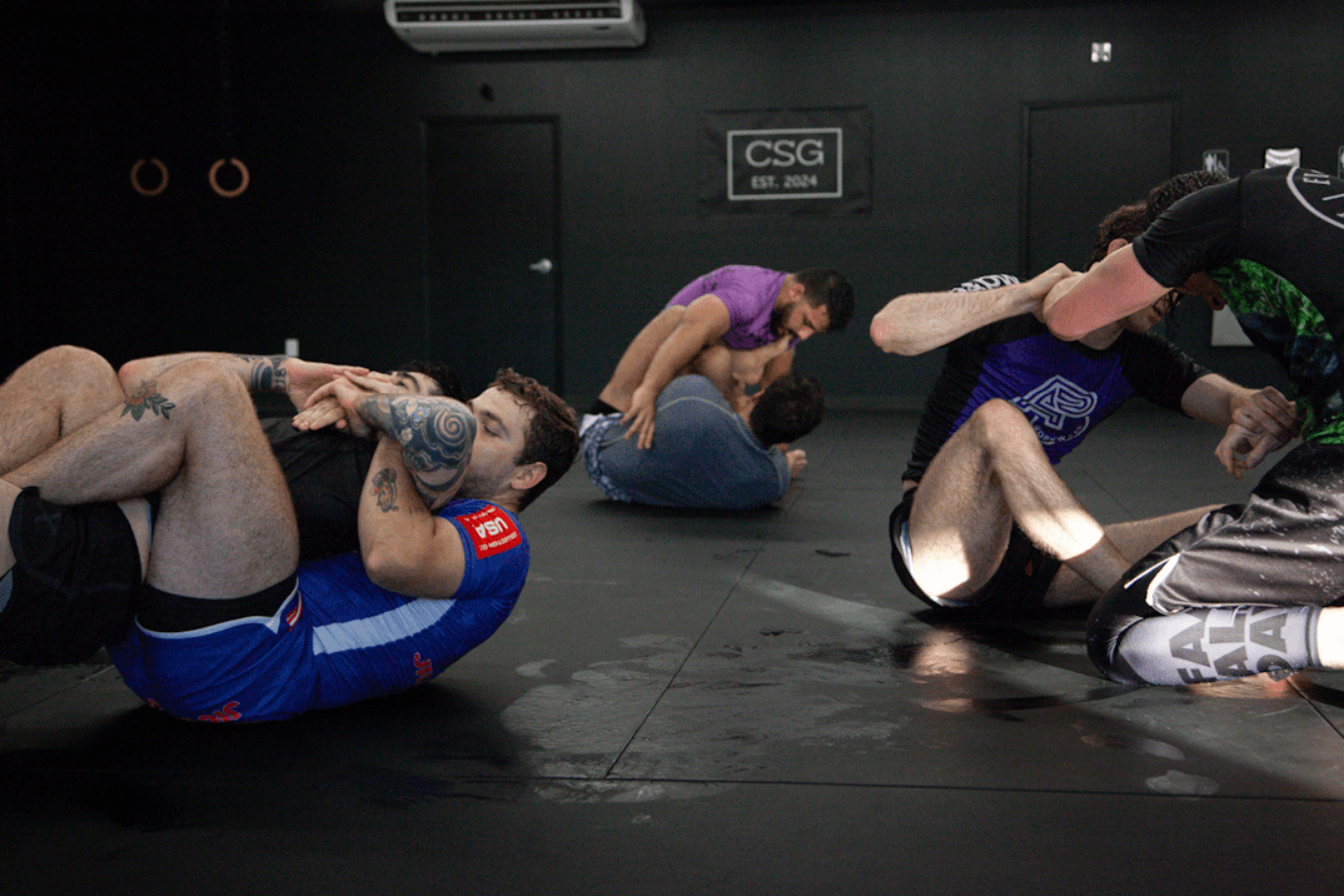
The fastest improvements in Grappling usually come from a few targeted reps done the right way, not from doing everything harder.
Progress can feel weird in Grappling: one week your timing clicks, the next week you feel like you are back at square one. We see this all the time, especially with adults balancing work, family, and a body that does not always love surprise intensity. The good news is that skill is trainable, and the right drills make skill show up on demand.
Our approach in Bridgeport is simple: we build your game from repeatable positions, then we pressure test those positions under increasing resistance. That means you are not just collecting techniques, you are building reactions you can trust when someone is driving into you, pulling you off balance, or trying to settle their weight.
In this guide, we are sharing breakthrough drills we use to help you move faster from “I know what I should do” to “I can do it while someone is fighting back.” If you train consistently, these are the types of reps that change your pace, your confidence, and your results.
Why drills accelerate Grappling faster than more sparring
Live rounds are essential, but sparring alone can turn into a loop: you repeat your favorite moves, you avoid your weak spots, and you learn slowly because you only see a situation once or twice per night. Drilling changes the math. You can see the same problem 30 to 80 times in a session, tweak one detail, then feel the difference immediately.
When we structure drilling well, you get three benefits at once. First, your technique becomes cleaner because you are repeating it under a clear constraint. Second, your conditioning improves in a way that matches actual exchanges, not just random fatigue. Third, your decision-making speeds up because you are practicing the “if this, then that” chain in real time.
The key is that drills should not feel like choreography forever. We want them to start clean, then turn messy in a controlled way, because real Grappling is messy.
The training principle that makes “breakthrough drills” work
Breakthrough drills share one idea: they create a narrow problem with an obvious win condition. If the goal is fuzzy, your reps get fuzzy. If the goal is sharp, your body learns faster.
We coach drills using three layers:
- Technical layer: your grips, head position, hip angle, and alignment.
- Timing layer: when you move relative to pressure, posts, or attempts to pummel back in.
- Energy layer: when to relax, when to squeeze, and when to sprint.
If you only train the technical layer, you look good in slow motion but stall in real rounds. If you add timing and energy, you start feeling “ahead” of exchanges. That is what people usually describe as a breakthrough.
Grappling movement drills that fix your base and balance
The base reset drill
A lot of adult beginners in submission grappling in Bridgeport struggle because they lose their base when the pace changes. Someone bumps them forward, they reach with their arms, and suddenly they are getting pulled into bad positions. This drill teaches you to reset your posture without panicking.
We start from a neutral stance or kneeling base. Your partner gives light pushes, snaps, or angle changes. Your only job is to keep your hips under you and recover to a stable base using steps, posts, and hip positioning. It sounds simple, but it trains the habit of “base first, then offense.”
The hip switch and angle chase
Many takedown and top control problems come down to angles. If your hips are stuck square, your pressure leaks out. We use a hip switch drill that builds the ability to rotate your hips while keeping chest connection, then chase the angle that keeps you safe and effective.
The goal is not speed at first. The goal is staying connected while changing direction. Once that becomes natural, we add resistance and make it feel like a real scramble.
The three drilling modes we use in adult classes
If you have ever drilled something and then could not hit it live, you are not alone. The missing piece is usually progression. We rotate drills through three modes so your brain and body adapt without getting overwhelmed.
1. Cooperative reps: you learn the shape of the movement and where your weight goes.
2. Guided resistance: your partner gives realistic reactions, but within a rule set.
3. Live from the position: you start in the exact scenario and spar to a clear endpoint.
That third mode is where “I can do it” starts replacing “I know it.” It is also where adult submission grappling in Bridgeport becomes fun, because you can measure progress in small, honest wins.
Positional Grappling drills that build escapes you can trust
The frame and hip escape ladder
Escapes are not one move, they are a sequence. We build them as ladders: frame, hip escape, recover guard, then upgrade to a better guard. In this drill, you start under controlled top pressure. Your partner stays heavy, but does not rush submissions. You work the ladder one rung at a time.
We coach you to feel when your frame is actually carrying weight versus when it is just a hand on a shoulder. That difference is huge. When your frame works, your hips become light enough to move. When it does not, you waste energy and get pinned again.
The underhook recovery race
Underhooks matter in almost every scramble. We train underhook recovery as a timed exchange: you start flattened or slightly turned, your partner tries to crossface and settle, and you fight to win the underhook and get to your side. Once you win it, you have to do something with it, like building to a knee shield or coming up to a single.
This is one of those drills that looks small but changes everything, because it teaches you to fight for position before you fight for a submission.
Submission chain drills that sharpen your finishing mechanics
The bite-by-bite finish drill
A lot of people “get to the move” but cannot finish because the end mechanics are sloppy. We fix that with bite-by-bite drilling: you pause at each critical checkpoint and feel what correct alignment is like. Then you connect the checkpoints smoothly.
For example, instead of squeezing harder, we focus on getting your elbows, wrists, and hips into a finishable structure. Finishes become surprisingly calm when the structure is right. You are not muscling, you are closing a door.
The catch-and-release submission flow
Flow drilling has a purpose when it is structured. We use a catch-and-release format: you catch a submission, your partner defends correctly, and you transition to the next best option without forcing it. The goal is not to “win” the drill. The goal is to stay one step ahead as defenses appear.
This is especially useful for adult students because it teaches efficiency. You learn to switch attacks before you burn out your arms, and your Grappling starts to look smoother without you trying to look smooth.
Takedown-to-control drills for real-world transitions
Many people train takedowns separately from ground control, then wonder why they get tired or lose position right after the takedown. We connect them. A takedown is not the end of a sequence, it is the beginning of top pressure and decision-making.
The finish, land, stabilize drill
We pick a takedown finish and drill the landing and stabilization as the main event. Your partner gives you a realistic reaction on the way down. You land, immediately control the hips or head, and freeze the position for one second. That freeze is your honesty check. If you cannot freeze, you do not actually have control yet.
From there, we progress to a short positional spar where the bottom partner tries to stand or re-guard. You learn to keep top position without needing to scramble like crazy.
The wall-wrestle clinch reset
In a tight room, a hallway, or a crowded mat edge, clinch positions matter. We use wall-wrestle style resets to practice pummeling, head position, and short finishes without relying on huge shots. This drill is about staying balanced, staying safe, and learning to win inches.
It also keeps training interesting, because it feels different than open-mat takedowns and teaches you to adapt.
How to structure your week for faster progress in Bridgeport
If you want to improve quickly, you do not need to train seven days a week. You need to train with enough frequency that your body remembers, and enough recovery that your joints do not hate you. For most adults, consistency beats intensity.
A simple weekly structure we like is:
- Two technical classes where drilling is the priority
- One day focused on positional sparring and specific rounds
- One optional session where you repeat your personal “problem positions” and get extra reps
If you are training submission grappling in Bridgeport and your schedule changes week to week, that is fine. The main thing is showing up often enough that you are not re-learning the same basics every time.
Common mistakes that slow down Grappling progress (and what we do instead)
We see a few patterns that quietly stall people out. None of these are character flaws. They are normal training habits that just need a better system.
One mistake is chasing novelty. New moves are fun, but fundamentals win because you can repeat them under pressure. We would rather you have two takedown entries you can hit reliably than ten you cannot start.
Another mistake is drilling with zero intention. If reps are casual, your body learns casual. We keep drills purposeful with clear start points, clear end points, and feedback you can use immediately.
Finally, a big one for adults is ignoring recovery. Soreness is normal, but constant pain is a signal. We coach pacing, smart partner selection, and gradual load increases so you can train for months and years, not just for a few heroic weeks.
Take the Next Step
If you want measurable improvement, the shortcut is not a secret technique, it is a smarter way to train. We build your Grappling around drills that sharpen timing, develop pressure, and turn common positions into reliable wins, whether you are brand new or trying to break through a plateau.
At Connecticut Submission Grappling, our adult program in Bridgeport is designed to make those breakthroughs feel repeatable. You will drill with purpose, pressure test your skills, and leave class knowing exactly what to focus on next time.
Train consistently and elevate your performance by joining a grappling class at Connecticut Submission Grappling.