
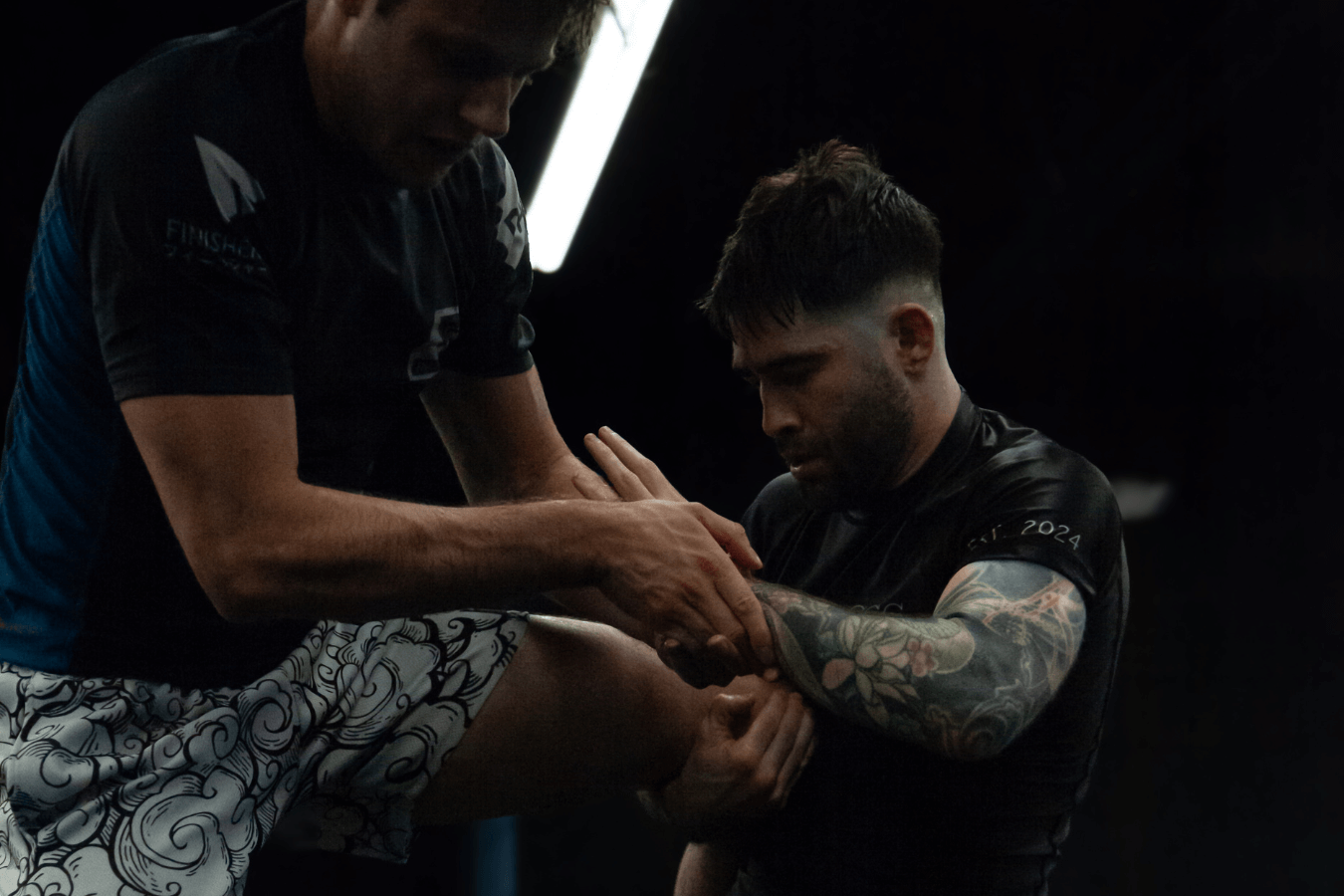
Grappling turns stress into something you can feel, name, and move through, one round at a time.
Bridgeport moves fast, and so do your thoughts when life stacks up. We see it every week: adults walking in with tight shoulders, restless sleep, and a brain that will not quite turn off. Grappling gives you a different kind of reset, not by zoning out, but by dropping into the moment so completely that the noise finally fades.
Our training is no-gi submission grappling, and we build every session around live, resistant movement. That matters for stress relief because your body has to solve real problems in real time, with a partner who is also moving. You end up breathing deeper, focusing harder, and leaving the mat with the satisfying feeling that you did something honest with your energy.
If you are looking for submission grappling in Bridgeport that feels practical, welcoming, and structured for adults with jobs, families, and long days, we have a clear approach: train live, scale intensity, and keep the room supportive.
Why Grappling Works When Your Brain Will Not Slow Down
Stress management advice often sounds like you should simply relax. The problem is that stress is physical. Your jaw clenches, your shoulders rise, and your nervous system stays on alert. Grappling is useful because it recruits your whole body and attention at once, which makes it hard to spiral mentally.
When you are hand fighting, framing, and working to improve position, your mind cannot multitask in the usual anxious way. You are present because you have to be. For many adults, that is the first time all day when attention is not fractured.
There is also a straightforward satisfaction in measurable effort. You can feel your breathing change from frantic to steady across rounds. You can feel your heart rate settle when you learn to stop panicking in a bad position. Those are not abstract wins. That is your nervous system learning a new pattern.
Live Training, Real Relief: Our No Gi Approach
We train in a way that stays rooted in reality: we do live rounds every class, scaled to your experience level. That structure is a big part of why people feel better after training. You are not just memorizing techniques. You are applying them under resistance, which builds confidence quickly.
Beginners do not get tossed into chaos. Our Foundations track uses controlled live games on specific positions like guard, pins, and escapes. That lets you experience the benefits of Grappling without feeling overwhelmed. You get the “in the moment” focus, but in a format that is safer and easier to understand.
As you grow, intensity grows with you. Advanced students do higher-output rounds, more standing engagement, and tougher problem-solving. The stress relief is still there, but it becomes paired with performance, conditioning, and sharpness that carries into daily life.
What Stress Looks Like on the Mat (And How We Coach Through It)
A lot of adults feel stress in the same few ways when they start:
• Holding their breath during scrambles
• Gripping too hard and burning out fast
• Rushing positions because being stuck feels uncomfortable
• Mentally checking out after one mistake
• Feeling embarrassed to ask questions
We coach against those patterns with simple reminders and repeatable habits. Breathe through your nose when you can. Build frames before you try to explode. Pause, settle, and recompose guard rather than forcing a low-percentage move. If you are newer, we will often slow the game down so you can feel the correct response instead of guessing.
And yes, the room matters. Stress drops faster when you are not bracing for judgment. We keep the vibe focused, but friendly, with training partners who want you to improve.
The Science of “Occupied Attention” and Why It Feels Like Calm
One reason Grappling is so effective for stress relief is that it demands occupied attention. You are processing grips, posture, balance, and timing. That makes it harder for your mind to loop on work emails, finances, or whatever is sitting heavy.
You also get immediate feedback. If your posture breaks, you feel it. If your base is weak, you get tipped. That feedback loop can sound intimidating, but it is actually soothing over time because the rules are clear: do the right thing, and you get a better outcome. Life is not always like that.
Training also gives you a physical outlet that is not just “go run until you are tired.” You are building skills while you sweat, and skill-building tends to stick in the brain as progress, not punishment.
Grappling Trends Show What Works Under Pressure
High-level no-gi competition gives a peek into what is reliable when athletes are under maximum pressure. Recent top events show submission rates in the roughly mid 30s to high 40s range, with chokes leading the way and wrestling playing an increasingly dominant role in how matches are decided. That is not just trivia. It reflects what works when the other person is resisting hard.
We use that same idea for regular adults: if it does not hold up under resistance, it does not belong at the center of your training. That is why we emphasize:
• Strong positional control before chasing submissions
• Standing engagements and takedown awareness
• High-percentage chokes and clean mechanics
• Escapes and guard retention that keep you safe when tired
From a stress standpoint, this is important because reliable fundamentals make training feel less chaotic. When you know how to survive and recover, your brain stops treating every round like an emergency.
What a Class Feels Like (So You Can Picture Yourself Here)
Most adults want to know what they are walking into. Fair. A typical session has a clear structure and a steady rhythm.
We usually start with a warm-up that looks like movement preparation, not random calisthenics. You will build hips, shoulders, and coordination for the specific positions we will be using. Then we teach a technique sequence with a purpose, like how to enter a guard, how to maintain it, and how to stand back up safely.
After that comes the live work. That is where the stress relief really kicks in because your attention snaps into place. Rounds can be full sparring for experienced students, or controlled positional games for newer students. Either way, you get real movement against real resistance, which is the whole point of no-gi Grappling.
You will leave tired, but usually in a clean way, like your body used up the stress chemicals it was carrying around.
Adult Submission Grappling in Bridgeport: Built for Real Schedules
Adult submission grappling in Bridgeport needs to fit into real life. Most people are not training for a podium. Most people are training to feel better, move better, and have something consistent that belongs to them.
Our class schedule is designed so you can build momentum. Foundations is there for beginners, and all-levels classes let you keep progressing without waiting for some imaginary “perfect time.” We also run open mats because unstructured rounds, at your own pace, are a different kind of therapy. You can work, experiment, ask questions, and breathe.
We also offer women’s-only free training sessions. That option matters, not as a separate universe, but as an on-ramp where some students can settle in, build comfort, and then branch into the wider room if and when they want.
How We Keep Training Intense Without Making It Unsafe
Stress relief only works if you can train consistently. Consistency requires safety. We take a few practical steps that protect your body while still keeping the training real.
1. We scale live rounds by experience so beginners are not thrown into full-speed chaos.
2. We teach tapping culture early and reinforce it, because longevity beats ego.
3. We match partners thoughtfully when possible, especially for new students.
4. We focus on position before submission, which reduces wild, injury-prone scrambles.
5. We encourage steady effort over “win every round” intensity, especially at the start.
The goal is that you can train next week, not just survive today. Over time, that steady exposure to manageable stress is what builds calm outside the gym.
Stress Relief You Can Take Home: Skills That Transfer Off the Mat
Grappling is physical, but the mental habits carry over. You learn how to stay calm in discomfort. You learn how to problem-solve without rushing. You learn how to breathe when your heart rate climbs. Those lessons show up at work, in traffic, and in tough conversations.
A common shift we see is that students stop reacting as quickly. Instead of snapping, shutting down, or spiraling, you pause, assess, and choose a better response. That is the same skill as escaping a pin: first you survive, then you build position, then you move.
Even your sleep can change because your body has had real exertion and your brain has had a clean break from mental noise. It is not magic. It is practice.
Take the Next Step
If you want stress relief that feels active, skill-based, and honestly kind of refreshing, we built our training around exactly that. Connecticut Submission Grappling is dedicated exclusively to no-gi, live training, and we keep it scalable so you can start where you are and grow from there.
When you are ready, we will help you plug into the class schedule, learn the fundamentals through controlled games, and experience why Grappling is one of the most reliable ways to find calm through movement in Bridgeport.
Apply what you learned here by joining a grappling class at Connecticut Submission Grappling.